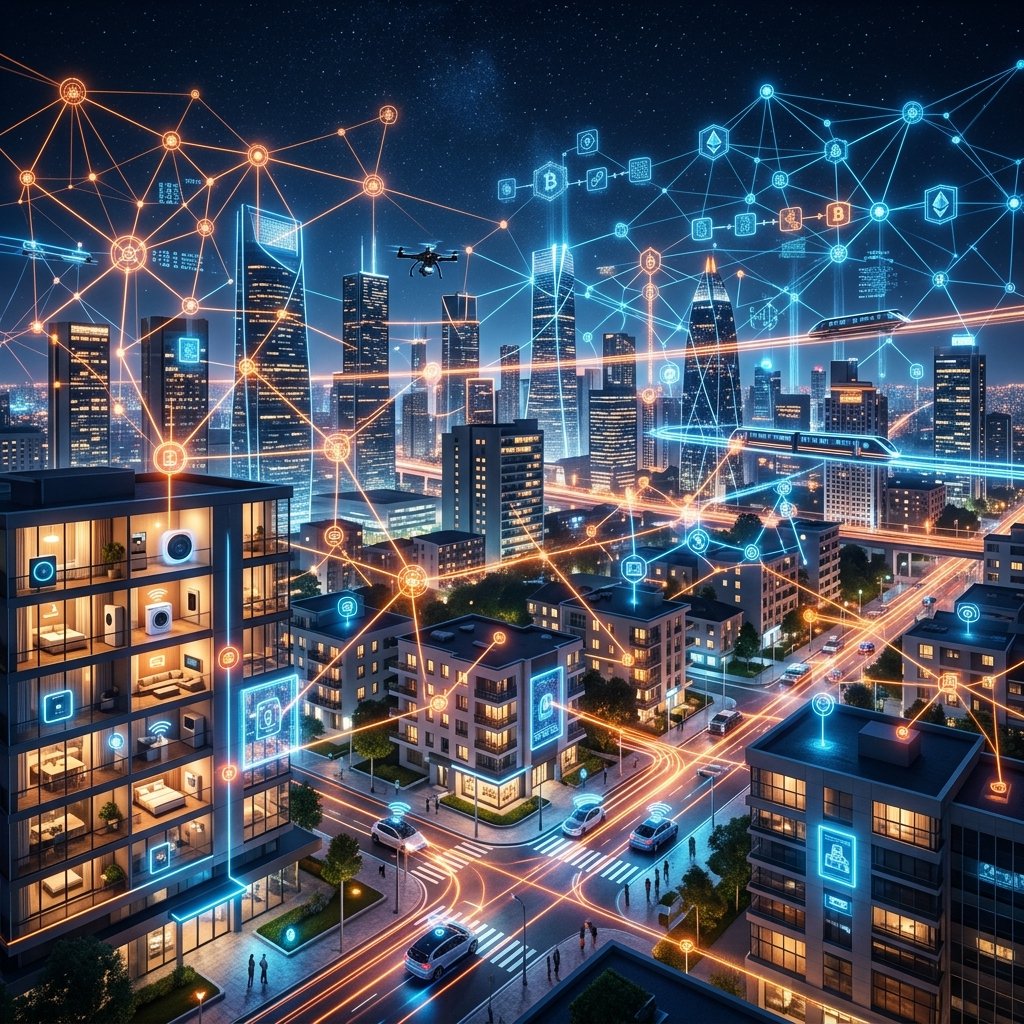
Imagine waking up in the morning and your alarm doesn't just wake you — it tells your coffee maker to start brewing, adjusts your thermostat to your preferred temperature, and sends a notification to your phone summarizing the day's weather and traffic. Your refrigerator notices you're running low on milk and adds it to your shopping list automatically. On your morning run, your smartwatch tracks your heart rate, calories, and route, syncing everything to an app on your phone. When you arrive at work, the building's smart lighting system detects your presence and turns on the lights in your office. All of this is the Internet of Things at work — and it's not science fiction. It's happening right now, in millions of homes, businesses, hospitals, and cities around the world. But what exactly is IoT? How does it work? And what does it mean for our future? In this comprehensive guide, we'll answer all of these questions and more, giving you a complete picture of one of the most exciting and impactful technology trends of our era.
What is IoT?
The Internet of Things (IoT) refers to the vast network of physical objects — "things" — that are embedded with sensors, software, and other technologies that enable them to connect to the internet and exchange data with other devices and systems. In simple terms, IoT is about giving ordinary physical objects the ability to collect information from their environment, communicate with each other, and be controlled remotely over the internet.
The "things" in IoT can be almost anything: your refrigerator, your car, an industrial sensor on a factory floor, a medical device monitoring a patient's vital signs, a traffic light that adjusts timing based on real-time congestion, or a smartwatch on your wrist. What they all have in common is that they are connected to the internet and can send and receive data.
The term "Internet of Things" was coined by British technology pioneer Kevin Ashton in 1999, though the concept has been evolving since then. Today, the scale of IoT is staggering: by 2024, there are estimated to be over 15 billion connected IoT devices worldwide — a number projected to surpass 30 billion by 2030. IoT generates more data than any other source, and its impact spans consumer electronics, healthcare, agriculture, manufacturing, transportation, and urban planning.
How Does IoT Work?
Understanding how IoT works requires looking at its four fundamental components that work together as a system:
1. Sensors and Actuators
Every IoT device starts with a sensor — a component that collects data from the physical world. Sensors can measure temperature, humidity, light, motion, pressure, heart rate, location (GPS), sound, air quality, and hundreds of other variables. Actuators are the complement to sensors — they take action in the physical world based on received instructions (turning on a motor, opening a valve, adjusting a thermostat).
2. Connectivity
Once data is collected by sensors, it needs to be transmitted. IoT devices connect via various wireless technologies depending on their needs: Wi-Fi for home devices, Bluetooth for short-range personal devices, Zigbee and Z-Wave for low-power smart home meshes, 4G/5G cellular for mobile and outdoor devices, and LPWAN technologies (like LoRaWAN and NB-IoT) for long-range, low-power sensors in agriculture and smart cities.
3. Data Processing
Once data reaches the cloud or a local server (called "edge computing" when processing happens close to the device), it's processed to extract meaningful insights. This processing might be simple (a temperature reading triggers an alert if it exceeds a threshold) or highly sophisticated (an AI model analyzes sensor data from thousands of factory machines to predict maintenance needs before a breakdown occurs).
4. User Interface
Finally, insights and controls are made accessible to people through apps, dashboards, alerts, or automation rules. You might receive a push notification on your phone, see data on a web dashboard, or have the system take action automatically without any human intervention.
Common IoT Devices
IoT encompasses an incredibly diverse range of devices. Here are some of the most common categories you'll encounter in everyday life:
- Wearables: Smartwatches (Apple Watch, Samsung Galaxy Watch), fitness trackers (Fitbit, Garmin), smart glasses, and medical monitoring devices.
- Smart Home Devices: Smart speakers (Amazon Echo, Google Nest), smart thermostats (Nest, Ecobee), smart locks, video doorbells (Ring, Nest Hello), smart bulbs (Philips Hue), and robot vacuums (Roomba).
- Connected Appliances: Smart refrigerators, washing machines, ovens, and dishwashers that can be monitored and controlled via smartphone.
- Smart TVs: Televisions connected to the internet for streaming, app usage, and voice control.
- Connected Vehicles: Cars with GPS tracking, remote diagnostics, over-the-air software updates, and vehicle-to-vehicle communication systems.
- Healthcare Devices: Glucose monitors, blood pressure cuffs, ECG monitors, and hospital equipment that transmits patient data in real time.
- Industrial Sensors: Equipment in factories, warehouses, and utilities that monitors performance, temperature, pressure, and output.
Smart Home IoT
The smart home is arguably the most visible and relatable application of IoT for most consumers. A smart home uses internet-connected devices to automate and remotely control lighting, heating and cooling, security, entertainment, and appliances. The goal is to make your home more comfortable, energy-efficient, and secure — while giving you convenient control from anywhere.
Smart speakers like the Amazon Echo (powered by Alexa) and Google Nest Hub serve as the brain of many smart homes — acting as voice-controlled command centers that connect to and control hundreds of other smart devices. Smart thermostats like the Google Nest Learning Thermostat learn your schedule and preferences over time, automatically adjusting temperature for comfort and saving an average of 10-15% on heating and cooling bills.
Smart security systems combine video doorbells, motion sensors, smart locks, and security cameras into a unified system you can monitor from your phone. You can receive alerts when someone approaches your door, see who's at the door via live video, and grant remote access to visitors even when you're not home. Smart lighting systems like Philips Hue let you control brightness, color temperature, and create automated schedules — and some systems can even sync your lights to music or movies for an immersive experience.
Industrial IoT (IIoT)
While consumer IoT grabs the headlines, Industrial IoT — also known as IIoT or Industry 4.0 — may have an even greater economic impact. IIoT applies IoT technology to manufacturing, energy, logistics, agriculture, and infrastructure to drive efficiency, safety, and automation at industrial scale.
Predictive Maintenance: Sensors embedded in industrial machinery continuously monitor vibration, temperature, sound, and other parameters. Machine learning algorithms analyze this data to predict when a machine is likely to fail — allowing maintenance to be scheduled proactively, before a breakdown occurs. This can reduce equipment downtime by up to 50% and maintenance costs by 25%.
Smart Agriculture: Farms use soil moisture sensors, weather stations, drone imaging, and connected irrigation systems to optimize water usage, reduce chemical inputs, and maximize crop yields. Precision agriculture IoT systems have been shown to reduce water usage by up to 30% while increasing yields.
Smart Energy Grids: IoT-connected smart meters enable two-way communication between utilities and consumers, enabling dynamic pricing, automated demand response, and more efficient distribution of renewable energy. Cities use smart grid technology to balance electricity demand and integrate solar and wind power more effectively.
Benefits of IoT
The Internet of Things offers a remarkable array of benefits across personal, business, and societal dimensions:
- Efficiency and Automation: IoT automates repetitive tasks and processes, reducing human effort and error. Smart thermostats adjust temperature automatically. Inventory systems reorder supplies when stock runs low.
- Better Decision Making: Real-time data from IoT sensors enables more informed, data-driven decisions in business, healthcare, and city management.
- Cost Savings: Predictive maintenance, energy optimization, and supply chain efficiency powered by IoT can generate enormous cost savings for businesses and consumers.
- Improved Quality of Life: From health monitoring to home automation, IoT makes daily life more convenient, safe, and comfortable.
- Environmental Sustainability: Smart energy management, precision agriculture, and connected transportation reduce energy consumption and environmental impact.
- Enhanced Safety: IoT-connected safety systems in factories, vehicles, and buildings can detect hazards and respond faster than humans, preventing accidents.
IoT Security Concerns
For all its benefits, IoT introduces serious security challenges that must be taken seriously. The explosive growth of connected devices has created an enormous new attack surface for cybercriminals, and many IoT devices have been designed with convenience in mind rather than security.
Common IoT security problems include: weak or default passwords that users never change; infrequent or non-existent software updates; unencrypted data transmission; no security monitoring or intrusion detection; and the long operational lifetimes of IoT devices that may outlast their security support period.
The consequences of IoT security failures can be severe. In 2016, the Mirai botnet malware infected hundreds of thousands of insecure IoT devices (routers, cameras, DVRs) and used them to launch a massive DDoS attack that brought down major websites including Twitter, Netflix, and Reddit. In healthcare, insecure connected medical devices pose risks not just to data but to patient safety.
The Future of IoT
The Internet of Things is still in its relatively early stages, and the coming years will bring transformative developments that will expand its reach and impact dramatically.
5G connectivity is a major catalyst for IoT growth. 5G networks offer speeds up to 100x faster than 4G with dramatically lower latency — enabling IoT applications that require real-time responsiveness, such as autonomous vehicles, remote surgery, and smart factory robotics. As 5G infrastructure rolls out globally, the number and capability of IoT devices will expand dramatically.
Edge computing — processing data locally on or near the IoT device rather than sending everything to the cloud — will become increasingly important. Edge computing reduces latency, preserves bandwidth, and keeps sensitive data local. This is essential for applications like autonomous vehicles and industrial safety systems where milliseconds matter.
AI integration will make IoT vastly more intelligent. Rather than simply collecting and transmitting data, future IoT systems will use onboard AI to analyze data locally, make decisions autonomously, and continuously learn and improve. The combination of IoT's data collection with AI's analytical power is sometimes called AIoT — and it may be the most transformative technology combination of the coming decade.
Smart cities — urban environments where IoT technology optimizes traffic management, public safety, energy distribution, waste collection, and environmental monitoring — represent perhaps the grandest vision of what IoT can achieve. Cities like Singapore, Barcelona, and Amsterdam are already implementing extensive smart city systems, serving as models for the connected urban environments of the future.
Conclusion
The Internet of Things is transforming the physical world into a vast, intelligent, interconnected system that generates unprecedented amounts of data and enables new levels of automation, efficiency, and insight. From the smartwatch on your wrist to the sensors monitoring a wind farm, IoT is quietly revolutionizing how we live, work, and interact with our environment. Like all powerful technologies, it brings both extraordinary opportunities and real challenges — particularly around security and privacy — that require thoughtful attention. As 5G, edge computing, and AI continue to advance, IoT will only grow more capable, more pervasive, and more central to our daily lives. Understanding it is essential for navigating the increasingly connected world we all inhabit.